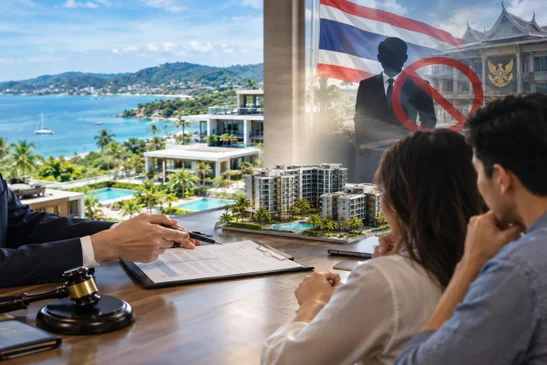
In light of the Thai government’s 2026 crackdown on nominee-based businesses, buying a condo in Phuket has become a more attractive option than a villa. Foreigners cannot own land in Phuket, but they can own structures like a condo. If one desires to invest in a Phuket property right now, a condo is the safest and simplest option. Although a condo unit can be purchased freehold and owned outright, there are certain requirements that must be met. The one that is of greatest interest to a foreign buyer is the 49% foreign ownership quota. Being informed of how this quota works is important before signing a purchase agreement, especially in a market like Phuket with so many foreign buyers.

Originally established way back in 1979, Thailand's Condominium Act stipulates that foreign ownership in a registered condominium cannot exceed 49% of the total area of the building’s units. When you see references to the "49% quota," this is what they mean.
One important aspect of this rule to understand is that it does not necessarily mean that only 49% of the individual units can be foreign-owned. This calculation is based on the total combined floor area of the condominium units. For example, let’s say a building has 10,000 square meters of total combined unit area – that means that no more than 4,900 square meters can be owned by foreign buyers. Again, all other areas such as a lobby, common areas, gym, parking lots, etc. are not included in this calculation. If a condo building has units of significantly different sizes, then this distinction is important.
If the foreign quota has already been reached, this typically means a foreign buyer cannot purchase another unit in that building as a foreign freehold owner. However, the quota is viewed per building, so if there are multiple buildings in a condo development, each one is considered separately.
If you find a condo you’re interested in buying that is advertised for sale as freehold, the very first step should be determining whether or not the foreign quota has been met already. If it has, then you cannot legally purchase a unit in that building. Obviously there’s no need to waste time with any other steps of the process if this is the case. To find out the foreign owner percentage in a specific building, contact the development’s juristic person, who should have that information readily available. If the quota has not yet been reached and you decide to buy a condo, the same person will have to provide an official document confirming this when registering the transfer with the Land Department.
Perhaps you noticed the mention of a “registered condominium” earlier in the article, which is another crucial detail to point out. If a building is to be separated into individual, privately-owned units, it must be officially registered as such. Under these rules, the development then has to designate a juristic person, a manager, and a board of directors. If a condo doesn’t have all of these things, or the person selling the unit claims that the 49% quota doesn’t apply to their building, these are huge red flags that could pose serious legal consequences.